Showing posts with label Game Play. Show all posts

Monday, June 25, 2007

Basic Training

ABOUT BASIC TRAINING
Many coaches mean - and not wrongly - that the players must get used to free passes and free pattern of movements at once, where the simple basic rules regarding running in front or behind are kept.

LEARNING:
However it is more easy for the players to understand the basic running lanes and passing possibilities, if they in the start (the first lessons) for instance by training in running in front and behind separately. During this the coach must make the basic rules clear. The players must lean the different possibilities regarding playing and passing by using an established (dictated) training course.

IMPORTANT:
This way of training must only be used in the learning phase or if the coach will teach the team a certain playing system, which suits the team.

UNDERSTANDING THE TRAINING:
It is important that both the coach and the players understand the idea with basic training and they are comfortable with the exercises.The basic play is exercises and ball exercises, where the players have the best conditions to train those passings, which are most natural (and by this also the best) to use in the attack play.

When the players (by training) become familiar with basic lanes and passing forms in the basic exercises, a greater speed and better rhythm in the play is obtained.

The result is that the players freely start to use the different passes, movement and running lanes in the attack play, when the situations occurs (at first during training and later in the match). This will give better chances for scoring, because the combinations will be performed faster, more secure and more confusing for the defense.

At the same time good play and shooting possibilities in the single situation occurs. The different basic play exercises are performed in a training circle. That means that ball- and maybe also player circulation is done without shooting. This causes a lot of repetitions of throwing, catching and running within a short time for all the players. A good way of training. Therefore remember: All effective training is in principle built on a lot of repetition. This gives a faster and greater learning effect.

Intention with the training:
It is also important that the coach and players understand, that it is not the intention, that the players - in the attack play - must feel themselves tied up to the basic movement and passing patterns.

In common the free attack play is build upon the piston movement, where the players play their own position. That means they have their own place during a 3-3 or 4-2 attack.

When a player opens/start an attack to obtain a scoring chance for herself or team-mates by using feints, running in, cross etc then the team-mates join the attack by crossing, screening and more, because they have experienced the movements during the basic training. If the scoring chance does not occur, the rhythm of the play is changed and by using free ball and player circulation, the reposition themselves and are ready for a new attack. If a scoring chance occurs while doing this, it is up to the players to use it.

REMEMBER:
It is quite common that the players only use a few consecutive combinations from the basic training , when they try to bring themselves into a shooting solution.
The basic play training must therefore be a natural part in the training. This is well used during warming up.
Make the players get used to train the exercises, which match their skill. Then the team will get used to use the combinations and passings from the basic training in their free play during a season, which again will give a more "chance creating" play.


BASIC RULES IN THE BASIC PLAYING EXERCISE DRAWINGS:

  1. The exercises normally starts with the ball/pass on the wings.
  2. The passes must be placed against/in front of the receiving player, while she is oriented against the ball and so early that she is able to react and catch the ball. This gives security in the play.Note: Backward passing can be trained later.
  3. A player running in (in front/behind) always runs all the way to the opposite back or wing.
  4. The wing players basic position is where the free-throw line and the sideline meets, and a running in player always runs between the goal circle and wing player.
  5. The wing players starts her running in (in front/behind) after having received the ball, and normally runs in after the pass
  6. The passing sequences are shown on the drawings, and is mostly from left wing to right wing and then reversed. This is valid for all running in exercises (in front/behind).
  7. The way of passing, which is suitable in the training exercises are normally for right handed players. Left handed players do the same in the opposite direction
  8. The rear court players must get used to the correct movements such as piston movement, crossings and so on, in the different combinations in order that the rhythm of the training is ideal.
  9. It is of great importance for the players (especially youth) that they learn all the positions while training. That means that they won't be tied to a certain position.Please do let the players during training get used to all the positions, so they will be comfortable with all the positions, passings and running lanes.
  10. If more players attend the training that the players, who are needed to 2 training teams (1 team at each goal) following possibilities can be used:
    a - Use 2 players on some of the positions in the basic training. Those players take turns.
    b - "Waiting players" are used on the positions and comes into action after - for instance - 3 training passes
    c - An extra circle is made by cones at the center line of the court, which gives the possibility of 3 training teams. (works fine)

Article extracted from http://dragoerhb.dk/e_index.html

Monday, May 14, 2007

Playing Time

The normal playing time consists of two halves of 30 minutes with a 10 minutes half-time break in between. The playing time for youth and juniors are shorter usually around 20 to 25 minutes per half.

In knock out games, overtime is played if the game ended in draw at normal time, usually after a 5 minutes break after normal time ended. The overtime period consists of 2 halves of 5 minutes, with a 1-minute half-time break. If the game is again tied after a first overtime period, a second period is played after a 5-minute break. This overtime period also has 2 halves of 5 minutes, with a 1-minute half-time break.

If the game is still tied, the winner will be determined by means of penalty throw.

Wednesday, May 2, 2007

Game Play

A standard match duration consists of two periods of 30 minutes each during which each team may call one time out. Normal league games are usually allowed to end in a draw, but in knockout tournaments, such as the of the Olympics, two extension periods of 5 minutes are played, and if they also end in a draw another two times 5 minutes has to be played. If each of these ends in a tie after the extra time the winner is determined by an individual shootout from the 7-meter line, where each team is given five shots. The rules of the shootout is similar to the one of soccer, where, if a winner is not found within the first ten shots, the players return to the shooting, until one team has missed and the other scored.

In two Olympic Finals of women's handball penalty shootout had to be used - both of them with Denmark participating (against Hungary in 1996 and South Korea in 2004) and both of them with Denmark as the winner.

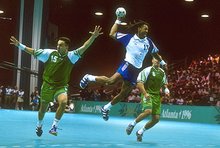
The game is quite fast and includes body and contact as the defenders try to stop the attackers from approaching the goal. Only frontal contact by the defenders is allowed. If a defender stops an attacker with his or her arms instead of his or her torso, the play is stopped and restarted from the spot of the infraction or on the nine meter line, with the attacking team in possession.

Penalties are given to players, in progressive format, if the contact between the players is particularly rough (even if it is indeed frontal). The referees may award a nine-meter free throw to the attacking team, or if the infraction was during a clear scoring opportunity, a seven-meter penalty shot is given. In more extreme cases they give the defender a yellow card (warning), a 2-minute penalty, or a red card (permanent expulsion).

For rough fouls they can also order two-minute expulsions and a red card expulsion without having to warn the player get lodt, if a player insults the referee - either by touching him with the intension to push or with verbal abuse, or if a player kicks or hits an opponent deliberately, the referee can expel the player forming a cross over his head with his arms, which will tell the player that he/she will have to leave the game hall completely. Both a red card or an expulsion will - if the referee does not regret his decision within twenty-four hours - result in a quarantine for the player shown out.


A team can only get three warnings (yellow cards), after that they will only be able to be penalised with 2-minute suspensions. One player can only get three 2-minute suspensions; after that he/she will be shown the red card, and cannot participate in that game anymore. However, a red card from three 2-minute suspensions does not result in a quarantine.

A Coach/Official can also be penalised progressively. After a yellow card and a 2-minute suspension, the red card is shown straight out, and unlike players, coaches cannot be shown a complete expulsion, but of course also be given a match quarantine. When shown a 2-minute suspension a coach will have to pull out one of his players for two minutes - note: the players is not the one punished and can be substituted in again, because the main penalty is the team playing with a man less than the other.

After having lost the ball during an attack, the ball has to be laid down quickly or else the player not following this rule will face a 2-minute suspension. Also gesticulatingly or verbally rejecting to follow the referee's order, as well as arguing with his/her decisions, will normally result in a 2-minute suspension.

Ball movement and possession is similar to basketball. If the attacker commits an infraction, such as charging, the possession of the ball can be awarded to the defending team. Players may also cause the possession to be lost if they make more than three steps without dribbling or after stopping their dribble. However unlike basketball, the player may take three steps instead of two (pivoting on one foot is considered a step) and the ball must be "patted" down instead of the more controlled basketball method.

The usual formations of the defense are the so-called 6-0, when all the defense players are within the 6 meter and 9 meter lines. The 5-1 formation is when one of the players cruises outside the 9 meter perimeter, usually targeting the center forwards. The least common is the 4-2 formation when there are two such defenders.


The usual attacking formation includes two wingmen, a center-left and a center-right which usually excel at high jumps and shooting over the defenders, and two centers. One of the centers tends to intermingle with the defense, also known as the pivot or line player, disrupting the defense formation, and the other being the playmaker. The formations are very variated from country to country. The most common formation for the central European teams is 6-0, but it can alternatively be extended to a 5-1, if you want a player, usually the far wing is placed as a disturbance for the other team in the middle in front of the 9-meter perimeter as the last man, to disturb the play of the other team.

There is also the 3-3 formation where the basis of play is with man marking all over the defensive area, which can make it really difficult for the attacking team to make any open chances. Primarily this formation is used by teams outside Eastern Europe only when behind with a few goals with a few minutes left, in the attempt to steal the ball faster.

Goals are much more common in handball than in most other sports, usually, both teams in a game score at least 20 goals.

Brunei Handball Chatroom

http://www.meebo.com/rooms